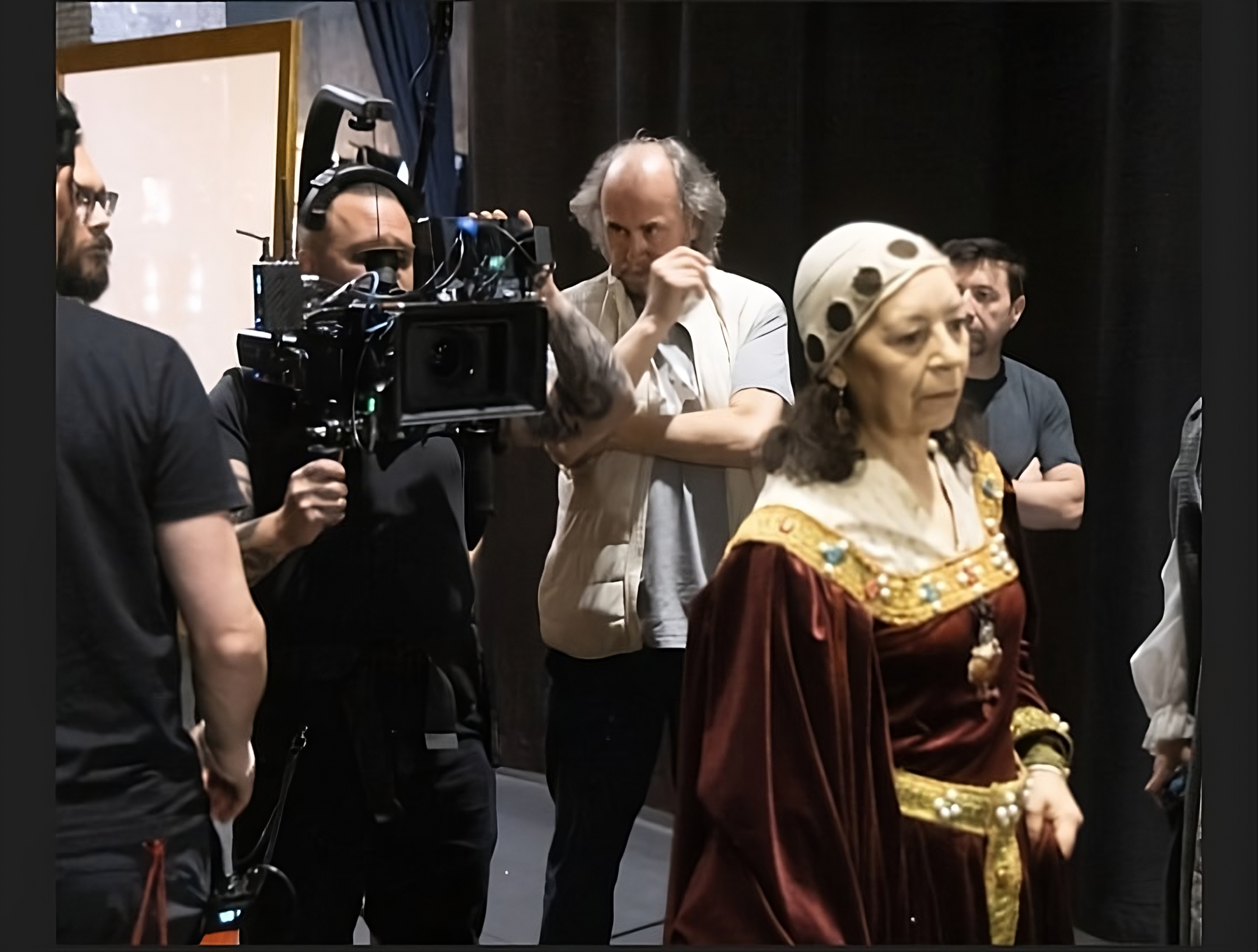
 The Secret Behind the Youssef Chahine Award for the Spanish Film “SECUNDARIAS” at the 41st Alexandria Mediterranean Film Festival
At the conclusion of Alexandria Heritage Days A Ptolemaic Newsletter and the Sailors Band Plays Mediterranean Tunes
Tamer Sallah Eldeen
By Tamer Salah El-Din - Egypt
Photographer: Abdul Qader Hussein
Alexandria lies between two eternal summer clouds, as if it predates history itself. To belong to this city is a choice and an honor; and the passport to its dreamlike land is imagination. The memory of the city is inspiring, like a blue apparition that refreshes awareness and fills the soul with love and peace. Alexandria has often been featured in legendary writings, where it is identified as the Egyptian city "Thonis/Tanis," located on the Canopic branch of the Nile. Tanis disappeared around 800 BCE due to seismic activity and was rediscovered in 2000 by a French expedition led by Professor Franck Goddio and his research team. It was an important hub for cultural and trade exchange between ancient Egypt and the Mediterranean world. It was also known as the Greek "Heracleion," where ancient Greeks believed Hercules himself visited and built a temple for his followers. This very city served as a capital of leisure, filled with pagan temples and entertainment venues that attracted wealthy traders and brought joy to sailors, just as it was a capital of ancient Egyptian and Greek religions.
However,
Tanis was not the only city at the present site of Alexandria. When Alexander
arrived, he found sixteen thriving villages, the most famous of which was
"Pharos," mentioned by Homer in his Iliad, a copy of which
Alexander the Great carried wherever he went. Pharos was described as "a port
where sailors could find refuge from storms and gather provisions," and
its naturally fortified position was an attractive feature that led the astute
Macedonian leader to establish his enduring capital for his vast empire.
Thus,
around a thousand years before Christ, Alexandria emerged as human settlements,
villages, and neighboring cities scattered like pearls along the eastern
Mediterranean shore, west of modern Egypt’s Delta. Remarkably, from its
earliest days, Alexandria's inhabitants were a mix of Egyptians, Greeks,
Cretans, Syrians, as well as North Africans and people from across the ancient
world. This made Alexandria inherently cosmopolitan from the very beginning.
Newly discovered artifacts have left no doubt that the Ramesseum (or
"the Ramesside") of the 19th dynasty collaborated with the Minoan
civilization of Crete and other "Sea Peoples" to build several
harbors along the Egyptian coast.
Among
the large cities that Alexander the Great encountered were vibrant settlements
that produced ships, fishing tools, baskets, ropes, and everything sailors and
fishermen needed. They were abundant with vegetables, fruits, and grains,
notably the Egyptian city "Ra-Kedet," meaning "protected by the
god." This name reflects its position between two bodies of water—the
Mediterranean to the north and the vast Lake Mariout to the south, which
originally covered more than 165,000 acres and connected with several branches
of the ancient Nile and the sea as well. The Egyptians, therefore, placed it
"under the god's protection." The name evolved into
"Rakotis" during the Ptolemaic era and "Raqoda" in Arabic.
This historical connection was revived as part of the fifteenth annual Alexandria Heritage Days, in the form of a "Ptolemaic Newsletter" imagined by a creative team led by film director and critic Islam Kamal, with implementation overseen by Alexandria intellectual Idris Hefny and a team of journalists, writers, researchers, and illustrators. Their work crowned the festival’s conclusion with an art exhibition of images and highlights of historical events featured in the imagined Ptolemaic-era magazine Rakotis. The festival closed with a musical performance by the "Sailors" band at the German Sailors' Club in Alexandria.
 Rakotis Magazine staff
Starting with Sebastian:
The
German Sailors' Club was founded in the early 20th century as a haven for
German sailors passing through, as well as for the city’s German residents, in
a location that continues to serve as a Mediterranean crossroads. Its current
director, Sebastian Drabonski, a friendly and welcoming figure well-versed in
the club’s history, shares with us: “The club was established in 1860 in the
Al-Gomrok district near the commercial port by a group of German sailors. It
served as a place for their accommodation and provided health and social
services to them and to the German community residing in Alexandria at that
time. Over the years, the club became a meeting point for numerous sailors,
foreigners, and Egyptians, enriching the cultural and social exchanges among
these diverse groups. About sixty years ago, the club moved to a historic villa
in the Wabour El-Maya district in Moharram Bey, where it added new activities
to its traditional ones, including hosting a variety of events and cultural
activities related to city life and special German occasions.”
Islam Kamal as Art Director for Rakotis:
Islam
Kamal, one of Alexandria’s prominent filmmakers, works as both a director and a
critic and is also the head of the Jesuit Cultural Center's Film Club. Having
founded Alexandria’s leading film studio years ago, Kamal has been active
across numerous cultural ventures, overseeing and managing film-related events
and workshops. Many regard him as a mentor in the art of cinema. Discussing
this project, he says, “We had the concept for creating a narrative on
Alexandria, from the descendants back to the ancestors, aimed at simplifying
the city’s vast and rich history in a way that sparks curiosity in the current
generation to seek out their roots. We thought about combining contemporary
details with historical facts to engage a broader audience.”
He
adds, “The starting point was to create a historical atlas framing the city’s
founding, which would give us more room for knowledge that spans from ancient
times to the present. Through the Alexandria Heritage Days project, organized
by the Alexandria and Mediterranean Research Center for the fifteenth
consecutive year, we were able to connect artists, writers, and researchers
with archaeologists and architects. Together, we created a platform that allows
us to share the city’s story with its residents, reminding everyone that
Alexandria has been continuously active since its establishment.”
On
Rakotis as a magazine, Kamal notes, “Rakotis is the product of
brainstorming among the participants; it’s like a roadmap to envision daily
life in the Ptolemaic city and convey its news using modern techniques. This
magazine, whose first issue we are celebrating, is the result of coordination
and collaboration among everyone involved.”
Generation Z and the City’s History:
Kamal continues, “We hope Rakotis will expand, and that each edition will reach a broader audience, especially the younger generation, or Generation Z, those born between 1998 and 2012. We designed the content and format of the publication to resonate with their preferences for uniqueness, modernity, and the intriguing aspects that draw them to historical figures. The magazine is characterized by a conceptual design that reminds readers that history is very much a part of our present experience.”
Impact Assessment:
When
asked about the publication’s impact and how its effectiveness might be
measured, Kamal responded, “The core of this experience is to observe how the
general audience receives it. The team posed questions related to the magazine
and the city’s history as a symbolic ‘test balloon’ or an informal survey,
sketching broad outlines that connect Alexandria’s early ancestors with their
present-day descendants.”
He
added, “The Rakotis experience also serves as a gauge of responses from
potential future partners regarding content creation, including illustrations,
writing, support, and the provision of resources for printing and distribution.
We are reaching out to grant-giving bodies to secure funding and workspace.”
Kamal
continued, “We begin by noting the Alexandrian identity. Historically, there
was something akin to Alexandrian citizenship—distinct from mere
sentimentality, negative bias, or partisan attitudes. We aim to preserve and
revive architectural aesthetics within homes, along with elements of taste and
fashion, particularly because there exists a common ground that can foster a
more refined dialogue about Alexandria’s uniqueness, which distinguishes it
from other cities.”
Strength and Momentum:
Islam
Kamal, with a calm yet determined gleam in his eyes, expanded on the project’s
future plans: “Today, we have stronger momentum than before. We’ve established
a precedent by assembling a team of writers and artists with a shared vision, a
variety of ideas, events, and more widely accessible media. We might create a
digital version of Rakotis in addition to the print edition, and we
intend to go even further through exchanges with other cultural initiatives and
institutions. We envision reintroducing historical frameworks into specific
corners of the city, motivated by what I like to call the ‘visible and
invisible.’ Our aim is to chart a new map of contemporary Alexandria, focusing
on places that warrant attention, such as iconic streets like the Canopic
Way—one of the oldest continuously used roads in the world—as well as
Alexandria’s walls and the rich stories they tell. Even the islands and bays
are themselves archaeological sites. In our time, locations like the Chamber of
Commerce Street are filled with Mediterranean architectural designs that blend
European creativity in a way that’s found nowhere else, likely because
Alexandria, unlike capitals such as Athens and Paris, was not ravaged in World
War II. Alexandria is thus well-suited to become an open-air Mediterranean
museum—one we currently walk through without recognizing the grandeur and
intricate fusion of its architectural styles.
A Commemorative Issue of a Ptolemaic Magazine:
Sometimes,
unusual ideas shine with a certain brilliance, and this seems to be what
sparked the creation of Rakotis’s inaugural issue. Film critic and
translator Rola Adel explains: “Rakotis is a part of the ancient city
itself. Our idea began with the notion of producing a commemorative issue of a
magazine named after this historic district, marking the publication of its
first issue as if it had been published thirty years prior. We imagined the presence
of news publications during the Ptolemaic era. The magazine’s writers and
artists envisioned themselves living in that time, taking verified historical
accounts and news and reworking them into a contemporary journalistic style.”
Regarding
her own contribution, she shares, “I wrote about the coronation of Ptolemy I,
covering the ceremonies and customary rituals of the time.” She adds, “I also
contributed another piece from the perspective of an Alexandrian citizen of
Egyptian descent who aspired to join the Ptolemaic army, only to be
disappointed by a royal decree that limited military service to Greeks alone.
He wrote an anonymous letter of grievance, lamenting the decision, as he had
dreamt from a young age of achieving the heroic feats recounted about the
state’s warriors in their conquests.”
Artistic Challenges and Archaeological Visits:
Among
the Rakotis team members, artist and art therapist Shorouk Raafat
describes her involvement in the publication: “The experience was entirely new,
as the magazine covers historical events as if we’re living them in the
present. It’s an attempt to document something we neither saw nor directly
experienced, which presented a unique challenge for both the form and the
content.” She continues, “We visited the Graeco-Roman Museum to immerse
ourselves in the past and refresh our understanding, allowing us to create
something inspiring and distinct, drawing on the styles of statues, clothing,
hairstyles, and predominant colors. We examined similarities and contrasts between
that era and our own.”
With the enthusiasm of a true artist, she elaborates, “I placed myself in the imagined characters’ shoes. For example, I created advertisements for perfumes but in clay containers, giving a historical feel to the viewer—even though exquisite glassware was also crafted in that era.”

Unique and Authentic Perspectives:
The
blending of talents in Rakotis includes not only directors,
intellectuals, translators, artists, and journalists, but also brings in
figures like Menna Allah El-Mesherfy—a PhD holder in agricultural sciences and
a researcher at the National Institute of Oceanography. Additionally, she is a
storyteller and literary critic who contributes creatively to the project.
Sharing her experience, she says, “I met Idris Hefny, the project’s executive
director, through various cultural events. He invited me to write, so I
expressed my vision in multiple styles, including storytelling. I chose to
write about ‘Echo,’ the lover of the Greek god Zeus, who betrayed his wife
Hera; Hera transformed the mistress into nothing more than an echo or ‘Echo’
herself.” She adds, “I crafted some advertisements, particularly promoting
women’s perfumes, and chose to present them in small, spherical containers
called aryballos, an ancient Greek vessel characterized by its rounded
shape, narrow neck, and wide mouth. These vessels were commonly used in ancient
Greece and other parts of the ancient world to store aromatic oils and
cosmetics.” Menna Allah also wrote about the founding of the Library of
Alexandria, which was originally called the Royal Library and even included a
zoo for research purposes. She contributed a piece on fashion trends in the
Ptolemaic era as well.
Naturally, the project generated more journalistic content and artwork than could fit into a single publication. This brings us back to Islam Kamal’s suggestion that Rakotis might benefit from additional issues or even an online platform.
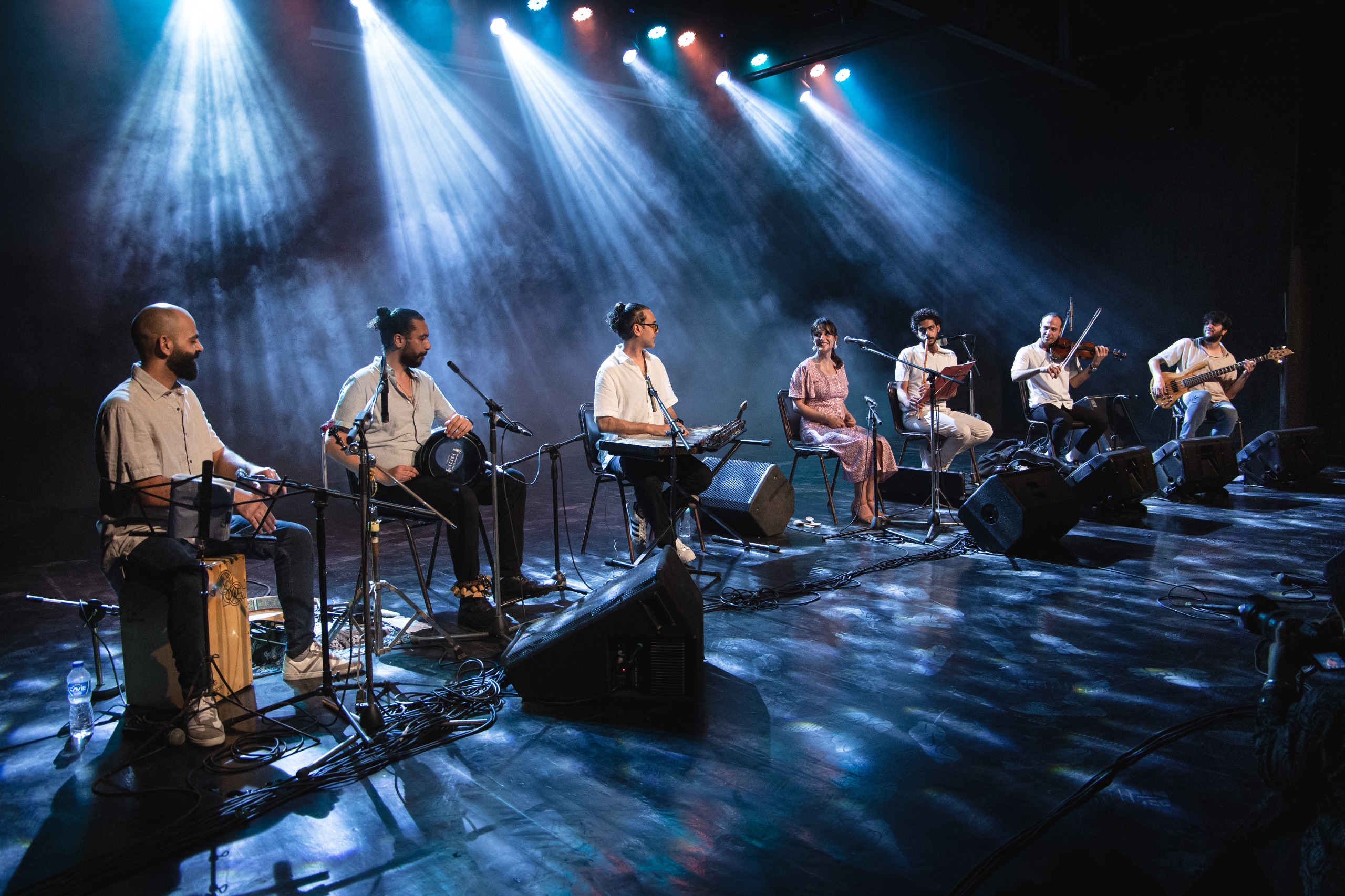
 The Turkish player Serap, and John Imad, the zither player
A Sailors’ Band at the German Sailors’ Club: Enjoy the song here
The
Alexandria and Mediterranean Research Center, with its fifteen-season
experience in working with Alexandrian heritage, creates unique networks to
spotlight lesser-known individuals, events, innovations, and locations. To close
out the activities, a relatively new musical ensemble, Bahara (Sailors),
with less than a year’s history, was invited to perform. The band began during
what was perhaps meant to be a passing visit by Turkish singer Serap Gigden
Sahen, who shares: “I came from Izmir, a city very much like Alexandria, to
learn Arabic and to hear Egyptian songs from the people here. I met two
musician friends, and we decided to collaborate, singing Turkish and Egyptian
folk songs with an eastern touch. Folk music has melodies that resonate
similarly across regions. My visit extended beyond a year, during which we
founded Bahara.”
Bishoy
Youssef, a percussionist with experience in the Creativity Center Choir and the
Library of Alexandria Choir, describes the band’s inception: “Serap performed
two songs with us on her first visit, and then we decided to form Bahara,
representing Mediterranean music from Egypt, Turkey, Greece, and other
countries where similar or even identical instruments are used. Popular tunes
in one country often find new life in another, with lyrics adapted to the local
language.” Introducing the members, he says, “We have Moamen Zakaria on
percussion, John Emad on the qanun, Andrew Nasser on violin, and Turkish
musician and singer Murat Kucukarslan. One of our most popular songs is
‘Aziza,’ originally by the late Zakariya Al-Hijjawi, which we also perform in
Turkish.”
نرشح لك
The Secret Behind the Youssef Chahine Award for the Spanish Film “SECUNDARIAS” at the 41st Alexandria Mediterranean Film Festival
 Michael Jackson, Prince and Paul McCartney: The Rivalries Behind Music Legends
 Between Celtic Enchantment and Egyptian Authenticity: Did the West Preserve the Forgotten Melodies of the Pharaohs?
 STRATEGIC COLLABORATION BETWEEN EL GOUNA FILM FESTIVAL, AIR TAXI EGYPT AND INVISIBLE MEDIA HOUSE
 Antiques in Your Home: Art, Wealth, and History
 From Tamer to Olga: Warm Letters Across the Mediterranean
 ? Why Has Arab Critical Taste Deteriorated and the Role of Critics Declined
 the Egyptian writer Naguib Mahfouz
 megan fox