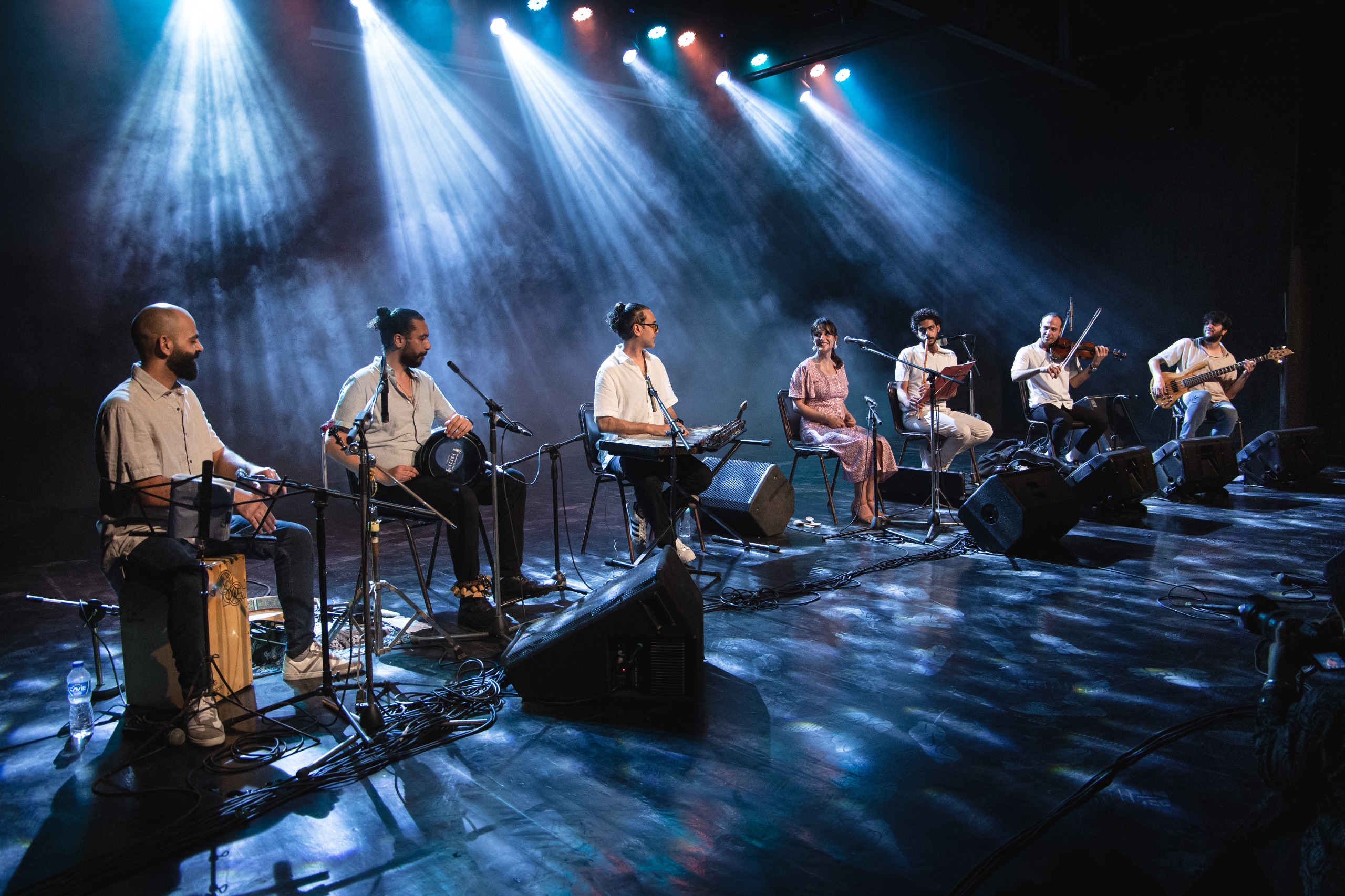
 At the conclusion of Alexandria Heritage Days A Ptolemaic Newsletter and the Sailors Band Plays Mediterranean Tunes
Between Celtic Enchantment and Egyptian Authenticity: Did the West Preserve the Forgotten Melodies of the Pharaohs?
Caffeine Art News

Maged El Haddad- Egypt
Music remains the only universal language that requires no translation. Yet, from an anthropological perspective, it carries the fingerprints of civilizations and the deep identities of peoples. When we contemplate the aesthetics of European music — particularly Celtic and Italian traditions — an intriguing question emerges: could these melodies still preserve ancient Egyptian “genetic traces” that Egyptians themselves lost amid centuries of foreign influence?
Celtic Music: A Cooling Balm for the Soul:
Celtic music stands among the most beautiful artistic expressions produced by the folk cultures of Northern and Western Europe, stretching from Ireland and Britain to Scotland. It is not merely music that delights the ear; it acts almost like a natural coolant for the human spirit, calming anger within the heart and transporting the mind to distant realms of forgotten cities hidden above mist-covered mountains.
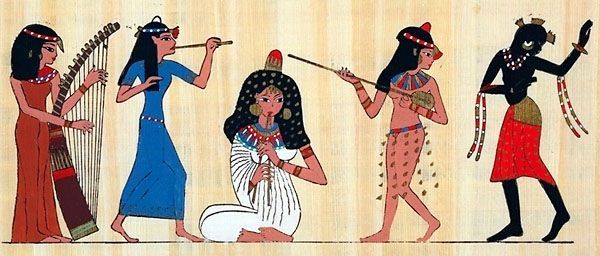
What distinguishes this musical tradition is its remarkable discipline, the clarity of its tonal structures, and the carefully interwoven resolutions within its melodic architecture. More strikingly, many of the instruments associated with Celtic music possess unmistakably ancient Egyptian origins, including the harp, flutes, and percussion clappers. Even the bagpipe may be viewed as a later evolution of primitive reed instruments, while the violin remains a comparatively modern addition with no direct Egyptian roots.
The Legend of “Scota” and the Journey North:
Scottish folklore preserves an ancient founding legend surrounding the Egyptian princess Scota, who is said to have fled Egypt and settled in Scotland, carrying elements of Egyptian culture and music with her. Although archaeology cannot conclusively verify such narratives from those distant ages, what remains fascinating is the possibility that Celtic music preserved fragments of ancient Egyptian musical spirit in a distinctly European form — long after those same elements had transformed within Egypt itself under Assyrian and Persian influences.
Where the East Meets European Geometry:
Italian music perhaps comes second only to Celtic music in emotional beauty. It may best be described as music of appetite, joy, and sensual warmth. Its genius lies in blending an Eastern emotional spirit familiar to Arab sensibilities with a uniquely European sense of structural precision and geometric perfection.
This artistic superiority appears even within the simplest melodies. Italian compositions often feel closer to the emotional transparency of the East than French music, which tends to favor sophistication over instinctive sentiment.
European Music Versus American Musical Chaos:
A comparison between European and American musical traditions reveals substantial differences:
* **Clarity and Focus:** European music possesses a stronger sense of tonal grounding and melodic coherence, allowing its emotional meaning to resonate more directly with listeners.
* **Romantic Melancholy:** European compositions encourage emotional contemplation, unlike many American forms that often appear “free to the point of chaos,” where expressive excess can overshadow the musical idea itself.
* **Civilizational Identity:** American music, despite its profound African roots, gradually lost much of its original cultural seasoning through later commercial and stylistic interventions. As a result, appreciating it sometimes requires intellectual interpretation more than instinctive emotional response.
Egyptian Resilience and Persian Expansion:
Historically, Persian and Mesopotamian musical influences began entering Egypt as early as the Hyksos period. Egyptian priests reportedly resisted introducing such music into temples in order to preserve the sanctity of native traditions. Yet with successive historical ruptures, Asian, Byzantine, and later Ottoman musical forms increasingly imposed themselves under the mantle of religious and political authority.
In contrast to the richness and layered complexity of ancient Egyptian musical traditions, Persian and Turkish music evolved largely through monophonic structures centered on single melodic lines, often prioritizing vocal ornamentation over harmonic imagination.
Escaping the Ottoman Shadow:
In the modern era, although Turkish and broader Asian musical forms deeply influenced even monumental Arab artists such as Umm Kulthum, major Egyptian innovators — including Sayed Darwish, Mohamed Abdel Wahab, and Ammar El Sherei — continuously attempted to refine and reduce what they viewed as excessive Ottoman musical looseness.
This effort eventually extended into the musical project of Mohamed Mounir, who sought to revive a distinctly Egyptian national musical identity.
Cultures inevitably exchange influences. Yet perhaps the deeper paradox remains this: what originated in Egypt was refined and preserved in parts of Europe, while the East itself became submerged beneath imported musical structures lacking the philosophical discipline once embedded by Egypt’s earliest ancestors as one of the sacred secrets of the gods.
Notes and Terminology
. Historical Rupture
By this term, the researcher refers to a pivotal historical moment in which a civilization becomes disconnected from its ancient cultural heritage and gradually adopts foreign artistic and social patterns due to major political, religious, or colonial transformations.
Within the context of this article, the term points to the rupture between the “Ancient Egyptian identity” and the modern Egyptian character. The researcher argues that Egyptians, particularly from the Late Period onward and more profoundly during the Middle Ages, ceased developing their original musical tradition — a tradition based on discipline, harmony, and structural precision — and instead absorbed waves of Asian musical influences, especially Persian and Turkish forms introduced by successive rulers.
Over time, these imported musical traditions came to be perceived as “authentic heritage,” while the genuinely Egyptian musical spirit either migrated into Europe through Greek transmission or survived in Northern European musical cultures, particularly among Celtic traditions.
Monophony
* **Literal Meaning:** “Mono” means one, while “phony” means sound — literally, “a single sound.”
* **Musical Meaning:**
Monophony refers to a musical structure built around a single melodic line performed alone, whether by an individual singer or a group performing the exact same melody simultaneously, without harmonic layering or independent accompanying voices.
* **In the Context of the Article:**
The researcher’s description of Eastern music as “sluggish monophony” refers to musical traditions centered on individual vocal ornamentation, improvisation, and elaborate melodic embellishments over a single tonal framework. In his interpretation, this creates a form lacking architectural musical depth or harmonic complexity.
Polyphony
* **Literal Meaning:**
“Poly” means multiple, and “phony” means sounds — literally, “multiple sounds.”
* **Musical Meaning:**
Polyphony is a compositional style in which several independent melodic lines interact simultaneously while remaining harmonically integrated. Choral music offers one of the clearest examples, where different vocal sections perform distinct melodic layers that merge into a unified musical texture.
* **In the Context of the Article:**
The researcher argues that ancient Egyptian music — which he believes later influenced Europe — possessed a polyphonic nature characterized by scientific structure, harmonic balance, and layered compositional coherence. In his view, this gave Egyptian music a sense of nobility and architectural integrity absent from later monophonic Asian traditions.
Interlocked” Musical Structure:
The researcher borrows this expression from architectural and woodworking terminology, particularly the concept of interlocking carved wood designs.
Musically, the term refers to compositions in which melodies, transitions, and cadences are tightly woven together with mathematical precision, leaving no room for randomness or structural emptiness. Each musical phrase naturally delivers the listener into the next with seamless continuity.
According to the article, this quality distinguishes Celtic music and reflects what the researcher considers an extension of the ancient Egyptian mentality renowned for engineering and structural mastery.
Sources and References:
* Hans Hickmann — regarded as one of the pioneering twentieth-century scholars of ancient Egyptian music. Among his works are *Musical Miscellanies* and *Forty Centuries of Music in Ancient Egypt*.
* Khairy El-Malt — a leading authority on ancient Egyptian music in the Middle East and supervisor of postgraduate studies in ancient Egyptian musical sciences. His lectures and book *Music and Society in Ancient Egypt* are among the principal references cited by the researcher.
* Iman Othman — specialist in Egyptology and the anthropology of Eastern civilizations, particularly in the fields of artistic appreciation and Egyptian social traditions.
* Plato — especially his works The Republic and Laws.
* R. G. Collingwood — particularly applications of his aesthetic theory.
* Mohamed Abdel Wahab — through his memoirs and reflections on musical identity.
* Ancient Egyptian archaeological evidence, including musical murals and instruments preserved in museums, as well as musical depictions and instruments from Mesopotamian civilization.
* Anthropological comparative studies conducted by Maged El Haddad concerning cultural elements and civilizational production.
Editor’s Note:
Keys to Understanding the Secrets of Music
Some of the terminology employed by researcher Maged El Haddad may initially appear highly academic, yet at their core these concepts speak directly to our everyday musical instincts and emotional memory.
When the article refers to “historical rupture,” it points to the moment in which Egypt abandoned its rigorous musical architecture in favor of imported ornamental traditions that gradually reshaped its sonic identity.
At the heart of the discussion lies the contrast between “monophony,” centered on the emotional seduction of a single melodic voice — a characteristic that later dominated Eastern music — and “polyphony,” the harmony of multiple interwoven voices that, according to the researcher, once defined ancient Egyptian musical roots before influencing the emotional landscape of Celtic Europe.
Ultimately, the article raises a provocative cultural question: are we capable of rediscovering a disciplined and structurally balanced Egyptian musical identity, or have we permanently embraced a more fluid and emotionally excessive Eastern musical spirit?
We invite readers to share their thoughts:
Do you hear echoes of an ancient Egyptian spirit within Celtic or Italian music that seem absent from much of contemporary Middle Eastern music today?
**Editor-in-Chief**
نرشح لك
At the conclusion of Alexandria Heritage Days A Ptolemaic Newsletter and the Sailors Band Plays Mediterranean Tunes
 The Secret Behind the Youssef Chahine Award for the Spanish Film “SECUNDARIAS” at the 41st Alexandria Mediterranean Film Festival
 Michael Jackson, Prince and Paul McCartney: The Rivalries Behind Music Legends
 STRATEGIC COLLABORATION BETWEEN EL GOUNA FILM FESTIVAL, AIR TAXI EGYPT AND INVISIBLE MEDIA HOUSE
 Antiques in Your Home: Art, Wealth, and History
 From Tamer to Olga: Warm Letters Across the Mediterranean
 ? Why Has Arab Critical Taste Deteriorated and the Role of Critics Declined
 the Egyptian writer Naguib Mahfouz
 megan fox